
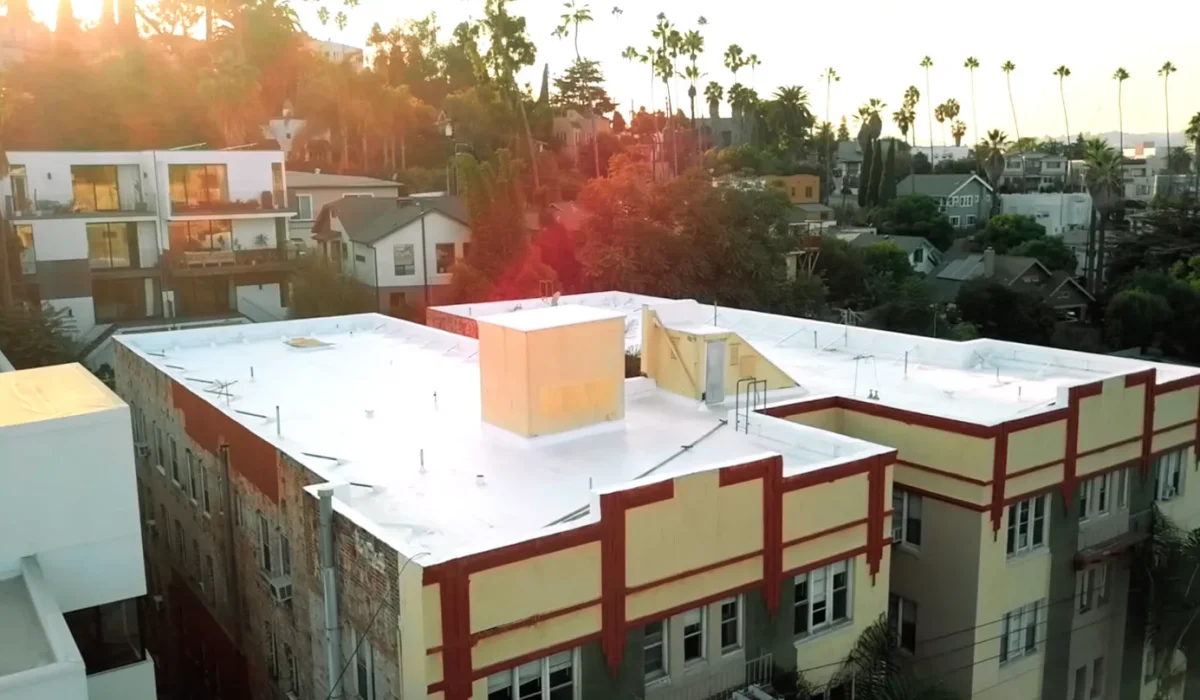
At Foam Roofing Los Angeles, we view spray foam roof insulation as one of the most effective ways to improve thermal performance, indoor comfort, and long-term roof durability in Los Angeles, CA. When properly designed and installed, a spray polyurethane foam roofing system does more than add insulation: it creates a continuous, fully adhered monolithic layer that limits heat gain, reduces uncontrolled air movement, supports cool-roof compliance, and helps commercial and residential property owners control operating costs in a climate where solar exposure and cooling demand are major performance drivers.
Why Spray Foam Roof Insulation Performs So Well in Hot, Sun-Exposed Climates
Spray polyurethane foam roof insulation is uniquely valuable because it combines several performance functions in one assembly. It insulates, air-seals, conforms to irregular substrates, and—when finished with a reflective coating—can also deliver cool-roof performance. The U.S. Department of Energy notes that spray polyurethane foam roofs are created by mixing two liquid components that react and expand into a single adhered layer, and that their protective coatings are usually reflective enough to provide cool-roof performance. That combination matters in Los Angeles because high solar loading drives roof-surface temperatures up, and roof temperature directly affects heat flow into the building below.
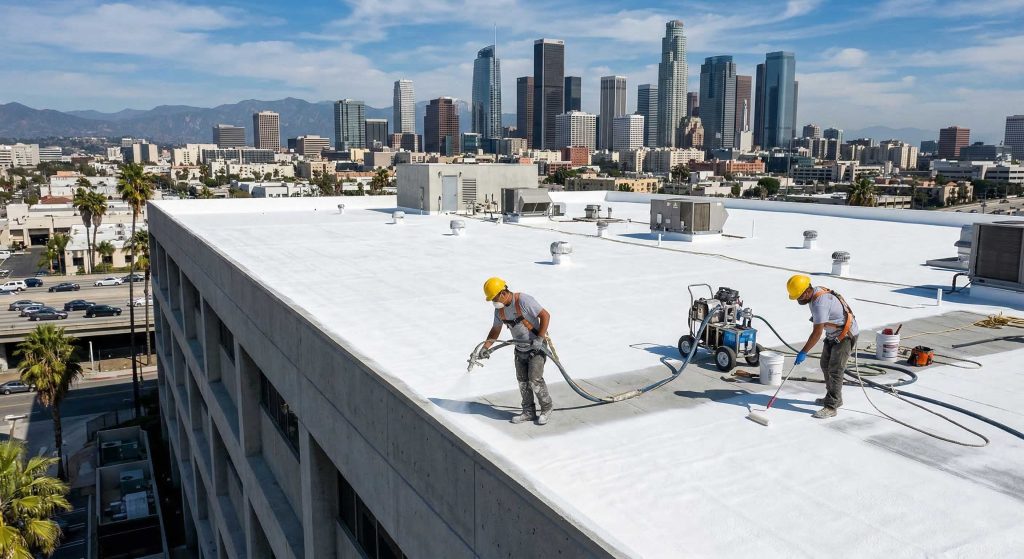
Unlike board insulation systems that rely on joints, seams, fasteners, and multiple interfaces, spray foam is field-applied in place. That seamless application reduces weak points where heat, air, or moisture can bypass the intended thermal layer. In practical terms, that means fewer thermal bridges, tighter envelope continuity around penetrations and transitions, and better real-world performance than assemblies that look equivalent on paper but contain discontinuities. DOE also notes that foamed-in-place polyurethane applications often perform better than board applications because the material molds itself to surrounding surfaces.
The Cool Roof Logic: Reflectivity, Thermal Emittance, and Why Surface Temperature Matters
Solar Reflectance: The First Line of Defense Against Heat Gain
A cool roof works by reflecting a larger portion of incoming solar radiation back into the atmosphere before that energy becomes heat in the roof assembly. The DOE explains that conventional roofs can reach 150°F or more on a sunny summer afternoon, while a reflective roof under the same conditions can stay more than 50°F cooler. That temperature difference is not cosmetic; it changes the thermal gradient across the roof and lowers the amount of heat driven downward into the conditioned space.
When a roof surface reflects more sunlight, less radiant energy is converted into sensible heat at the membrane surface. That means the roof deck, plenum, and top-floor ceiling assembly are subjected to a lower thermal load. In Los Angeles, where long periods of strong sun create recurring afternoon peak demand, lower roof-surface temperatures translate into lower attic or ceiling-zone heat gain, less compressor run time, and a smaller burden on rooftop units and split systems. EPA states that, in air-conditioned residential buildings, solar reflectance from a cool roof can reduce peak cooling demand by 11–27%.
Thermal Emittance: Releasing the Heat That Is Not Reflected
Reflectance is only half of the cool-roof equation. Thermal emittance describes how effectively the roof surface releases absorbed heat by radiating it away. California’s Energy Commission explains that a higher emittance value means more energy is released from the material as thermal radiation, while lower-emitting materials hold more heat, become hotter, and drive more heat downward into the building. In other words, a truly effective cool roof both reflects incoming energy and sheds the heat it does absorb.
This is exactly why coated spray foam roof systems are so effective in hot-weather applications. The insulation layer resists conductive heat flow, while the reflective coating improves solar reflectance and thermal emittance at the exposed surface. That dual-action approach is fundamentally different from relying on insulation alone. Insulation slows heat transfer; a cool surface reduces the amount of heat that must be resisted in the first place. For building owners, that means a better-performing envelope and a more stable indoor environment during afternoon heat spikes.
Spray Foam Roof Insulation R-Value Per Inch: Why Thickness and Density Matter
Closed-Cell Polyurethane and High Thermal Resistance
The thermal performance conversation starts with R-value, but it should not end there. DOE materials on polyurethane insulation explain that closed-cell polyurethane foam has high-density closed cells filled with gas, which is what gives the material its comparatively high thermal resistance. DOE also notes that closed-cell polyurethane can experience thermal drift as some low-conductivity gas is replaced over time, with most of that drift occurring in the first two years, after which the R-value remains stable unless the foam is damaged.
For roof assemblies, this matters because spray polyurethane foam delivers high R-value per inch relative to many common insulation materials while also providing air-sealing benefits that standard R-value comparisons do not fully capture. DOE’s Building America guidance cites typical closed-cell spray foam at about R-6 per inch, while broader SPF guidance places SPF products in an approximate range of R-3.5 to R-7.0 per inch depending on formulation and density.
Practical Thickness Targets for Real Roof Performance
Because roof SPF commonly performs near the R-6 to R-6.5 per inch range, thickness decisions have meaningful economic and compliance implications. A 1.5-inch application may deliver roughly R-9 to R-10; 2 inches lands near R-12 to R-13; 3 inches approaches R-18 to R-19.5; and 4 inches can move the assembly into the roughly R-24 to R-26 range, subject to product-specific tested values and design assumptions. Those numbers are not merely academic. They affect surface temperature moderation, underside deck temperature, HVAC runtime, and the building’s ability to resist heat gain during prolonged sun exposure.
In practice, optimal thickness should be selected based on building use, occupancy schedule, existing roof condition, local code pathway, and target energy performance. For many low-slope roofs in warm Southern California conditions, thicker SPF can materially improve summertime comfort because each added inch increases thermal resistance continuously across the field of the roof, around penetrations, and through transitions where board systems often become more complex and less continuous. That is one reason Foam Roofing Los Angeles typically evaluates thickness not as a generic number, but as a building-specific performance decision tied to cooling load, existing assembly, and long-term operating cost.
Title 24 and Spray Foam Roof Insulation: How the System Supports Compliance
What Title 24 Requires for Cool Roof Performance
California’s Building Energy Efficiency Standards are contained in Title 24, Part 6, and the California Energy Commission states that these standards are updated every three years. For residential prescriptive cool-roof requirements, the current California Energy Commission compliance materials show that low-sloped roofs in Climate Zones 13 and 15 must meet a minimum three-year aged solar reflectance of 0.63, minimum thermal emittance of 0.75, or minimum SRI of 75. For steep-sloped roofs in Climate Zones 10 through 15, the prescriptive requirement is 0.20 aged solar reflectance, 0.75 thermal emittance, or SRI 16.
California’s compliance manual also makes clear that cool-roof values are based on Cool Roof Rating Council (CRRC) tested aged reflectance and thermal emittance. That detail is important because compliance is not based on marketing language; it is based on rated product performance. The same manual notes exceptions and also allows projects to pursue the performance approach, meaning the design team can sometimes trade off prescriptive elements if whole-building performance is demonstrated appropriately.
Why Spray Foam Is So Well Suited to Title 24-Oriented Roof Design
Spray foam helps support Title 24 goals in three separate ways. First, it adds continuous insulation with high R-value per inch. Second, it creates an air-sealed roof surface that reduces uncontrolled heat movement. Third, when topped with a reflective elastomeric coating, it can satisfy the cool-roof logic that California emphasizes through aged reflectance, thermal emittance, and SRI metrics. The California Energy Commission specifically explains that a cool roof with high reflectance and high emittance produces a cooler roof and a cooler building with lower air-conditioning costs.
Los Angeles County spans multiple California climate zones, so the exact compliance path depends on the project location and building type. That is why any Title 24 conversation should begin with project-specific climate-zone verification through the California Energy Commission’s climate-zone tools rather than broad assumptions. Once the climate zone and occupancy are confirmed, spray foam thickness, coating selection, and documentation can be aligned to the appropriate prescriptive or performance path.
For owners comparing systems, this is the key distinction: spray foam is not just “insulation on the roof.” It is a system that can simultaneously address thermal resistance, air leakage control, and reflective surface performance, which makes it unusually well aligned with California’s energy-code priorities. For official technical background on cool-roof behavior, see the U.S. Department of Energy’s guide to cool roofs, and for California code structure and compliance context, review the California Energy Commission’s.
How Spray Foam Roof Insulation Reduces HVAC Strain and Cooling Costs
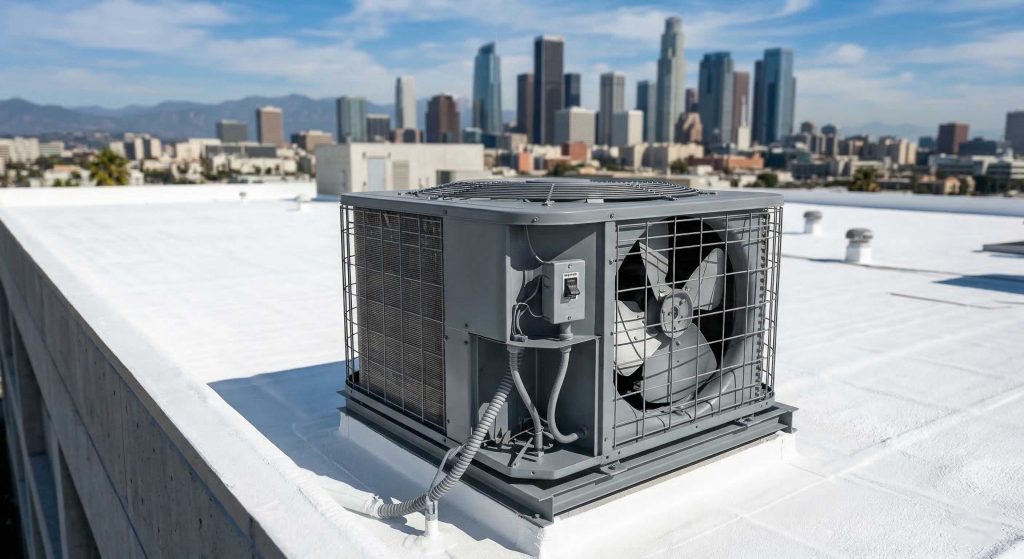
When roof heat gain drops, mechanical systems do less work. That means shorter cooling cycles, lower peak demand, less midday thermal overshoot, and reduced wear on compressors, blower motors, and rooftop package units. DOE states that cool roofs achieve their greatest cooling savings in hot climates, and DOE’s educational materials report measured energy savings of up to 10–15% for homes with cool-roof coatings. EPA further notes measurable reductions in peak cooling demand from reflective roof performance.
For commercial properties, the value can be even greater because large low-slope roofs create enormous solar collection surfaces. Every square foot that absorbs less heat reduces the sensible load imposed on the conditioned space below. That is especially relevant for warehouses, offices, retail buildings, churches, mixed-use properties, and multifamily top-floor units where roof exposure is direct and prolonged. Lower roof temperature also helps moderate temperature swings across the assembly, which can reduce thermal stress on coatings and substrates over time.
Economic return should therefore be evaluated across three categories rather than one: direct cooling-energy savings, deferred equipment strain, and avoided roof-disruption costs due to the seamless, renewable nature of properly maintained SPF systems. A roof that cuts heat gain, reduces air leakage, and can be recoated rather than fully torn off at every service-life interval has a fundamentally different lifecycle profile than roofs that depend on repetitive replacement cycles.
The Seamless Application Advantage: Why Monolithic Coverage Changes Performance
A major weakness in many roof assemblies is not the field membrane; it is the transition details. Curbs, drains, penetrations, parapets, pitch pockets, and irregular substrate conditions are where heat, moisture, and leaks often begin to exploit the system. Spray foam’s application method is valuable because it expands in place, conforms to these transitions, and creates a fully adhered, self-flashed field when installed correctly. DOE specifically notes that sprayed polyurethane performs well because it molds itself to the surfaces it is applied to.
That matters for energy efficiency because discontinuities in the insulation layer are not just waterproofing risks; they are also thermal bypass points. A seamless sprayed application reduces convective looping and air movement pathways that can undermine nominal R-value. In effect, the building benefits not only from insulation thickness, but from insulation continuity. That distinction is often the difference between theoretical performance and actual comfort. Foam Roofing Los Angeles emphasizes this systems approach because roof performance should be measured by whole-assembly behavior, not by a single product number in isolation.
Environmental and Long-Term Building Performance Benefits
Spray foam roof insulation contributes to environmental performance primarily by lowering cooling energy use and reducing peak electrical demand during hot weather. EPA states that cool roofs reduce energy use for air conditioning and can reduce associated greenhouse gas emissions. DOE and EPA also both frame cool roofs as part of broader heat-island mitigation strategy, which is particularly relevant in dense urban regions where dark surfaces intensify ambient temperatures.
There is also a lifecycle sustainability argument. A renewable SPF roof system that is periodically recoated can extend service life while avoiding some tear-off waste associated with conventional replacement cycles. When owners combine a reflective surface, high thermal resistance, and restorative maintenance, they often achieve a more resource-efficient roofing strategy over time than systems built around repeated disposal and replacement. That does not eliminate the need for inspections or maintenance, but it improves the long-term sustainability profile of the roof as an asset.
When a Free Roof Assessment Becomes the Smart Financial Move
Not every building needs the same foam thickness, coating chemistry, drainage correction, or compliance path. Some roofs need restoration. Others need tapered improvements, wet-area removal, or substrate preparation before SPF becomes a viable solution. The financially correct decision starts with field evaluation, not guesswork.
That is why we recommend scheduling a Free Roof Assessment. A proper assessment should determine the current roof condition, identify moisture risk, review existing insulation value, confirm climate-zone and code considerations, and map where spray foam roof insulation can deliver the best return through energy savings, comfort improvement, and long-term roof renewal potential.
Conclusion
Spray foam roof insulation is one of the few roofing solutions that improves thermal resistance, air-sealing, cool-roof performance, and roof continuity in a single integrated system. In a market like Los Angeles, where intense sun, long cooling seasons, and energy-code expectations shape roof design, that combination is exceptionally valuable. A properly coated SPF roof can stay dramatically cooler than a conventional dark roof, reduce heat flow into the building, lower HVAC strain, support Title 24-oriented design strategies, and provide high R-value per inch across a seamless monolithic surface.
For owners who want a roof system that performs as both a weather barrier and an energy asset, spray foam is not a marginal upgrade; it is a strategic building-envelope improvement. The next step is a Free Roof Assessment to determine the right thickness, coating system, and compliance approach for the specific roof, climate exposure, and long-term operating goals of the property.
Explore the ultimate guide to installing an SPF roofing system—click here to learn more.
FAQ
1. How much R-value does spray foam roof insulation actually add?
Closed-cell spray polyurethane foam commonly delivers about R-6 per inch, with many roofing products falling in the broader approximate range of R-3.5 to R-7.0 per inch depending on formulation and density. In practical roof design, 2 inches typically yields around R-12 to R-13, 3 inches around R-18 to R-19.5, and 4 inches around R-24 to R-26, subject to product-specific data and design assumptions. The important point is that SPF adds that thermal resistance as a continuous adhered layer, which helps the roof perform more effectively in the field than discontinuous insulation assemblies with joints and fasteners.
2. Does spray foam roof insulation help with Title 24 compliance in California?
Yes—when properly designed. California’s Title 24 framework emphasizes both insulation performance and cool-roof behavior. For certain residential low-slope roof applications, California Energy Commission materials show minimum prescriptive values of 0.63 aged solar reflectance and 0.75 thermal emittance, or SRI 75, in applicable climate zones. A spray foam roof topped with a properly rated reflective coating can support that cool-roof strategy while also adding continuous insulation and air sealing. Final compliance, however, depends on the building type, exact climate zone, reroof versus new construction status, and whether the project uses a prescriptive or performance pathway.
3. Will spray foam roof insulation noticeably reduce cooling bills and improve comfort?
In hot climates, it often does. DOE states that reflective roofs can stay more than 50°F cooler than conventional roofs under the same sunny conditions, and DOE educational materials report measured savings of up to 10–15% for homes with cool-roof coatings. EPA also reports that cool-roof reflectance can reduce peak cooling demand by 11–27% in air-conditioned residential buildings. When that reflective surface is paired with spray foam’s continuous insulation and air-sealing properties, buildings typically gain better indoor temperature stability, less afternoon heat buildup, and lower HVAC workload. Actual savings depend on roof size, insulation thickness, building use, HVAC condition, and how much of the roof’s solar heat gain was previously entering the occupied space.
Mail us for information
Emergency Phone