
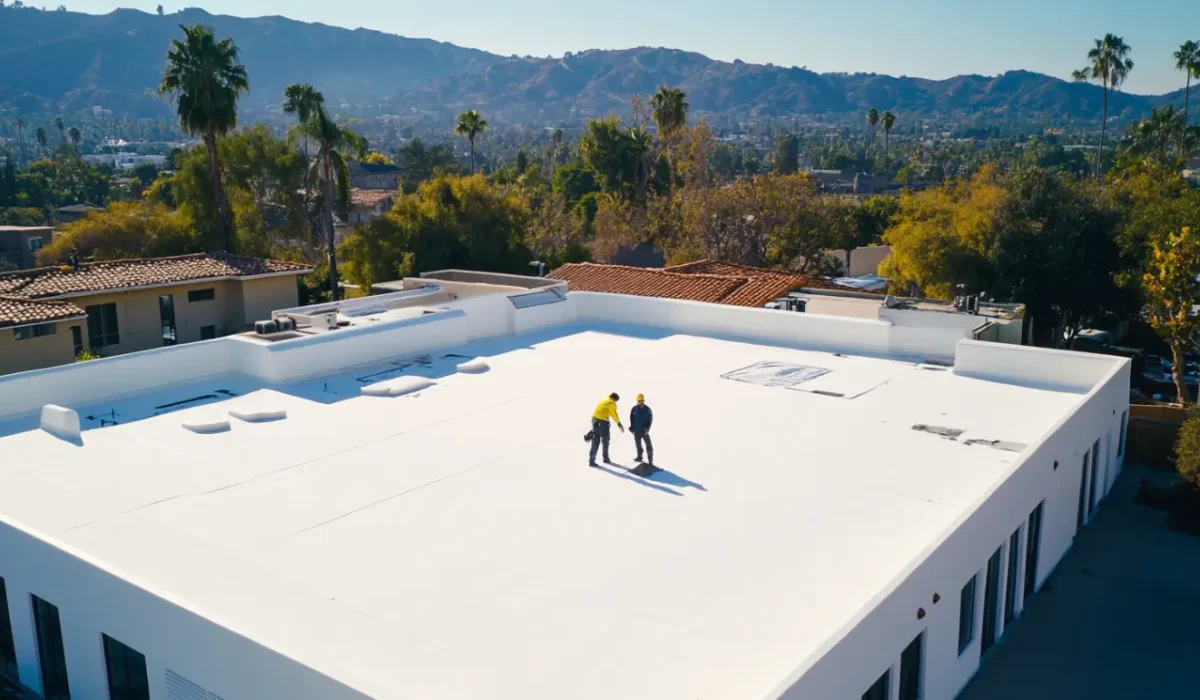
Installing a commercial Spray Polyurethane Foam roof is not a basic overlay job. It is a controlled, field-manufactured roofing process that has to be executed in the right sequence to perform under Los Angeles conditions. At Foam Roofing Los Angeles, we engineer SPF systems for commercial buildings by focusing on the stages that actually determine long-term performance: substrate qualification, moisture control, calibrated application, drainage correction, silicone protection, and final quality control.
That installation focus matters in Southern California. Commercial roofs in Los Angeles face high UV exposure, heat stress, heavy rooftop traffic, and drainage issues that can quickly expose shortcuts in workmanship. A properly installed SPF system can create a seamless, highly insulated, self-flashing roof assembly. A poorly installed one can lock hidden moisture, weak adhesion, and drainage flaws into the building from day one. This is the installation guide commercial owners should understand before approving an SPF project.
Phase 1: Roof Qualification and Substrate Preparation
Every successful SPF installation begins with one decision: whether the existing roof is actually a good candidate for SPF.
We start by evaluating the full roof assembly, not just the visible surface. That includes substrate condition, trapped moisture, deteriorated areas, penetration density, parapet transitions, drainage patterns, and whether the roof qualifies for recover or restoration. If insulation is wet, if the deck is unstable, or if surface contamination is severe, those conditions have to be corrected before spraying begins.
Once the roof qualifies, substrate preparation becomes the foundation of the system. SPF bonds directly to the prepared surface, so the roof has to be clean, dry, stable, and properly repaired. This stage may include:
- removal of debris, dust, and residue
- cleaning oils, loose gravel, and deteriorated surface material
- removal of wet roofing components where required
- correction of damaged sections and weak transitions
- primer where the substrate or specification requires it
This is one of the most important phases of the entire project because poor preparation is one of the most common causes of adhesion loss, blistering, and early SPF failure.
Contact Us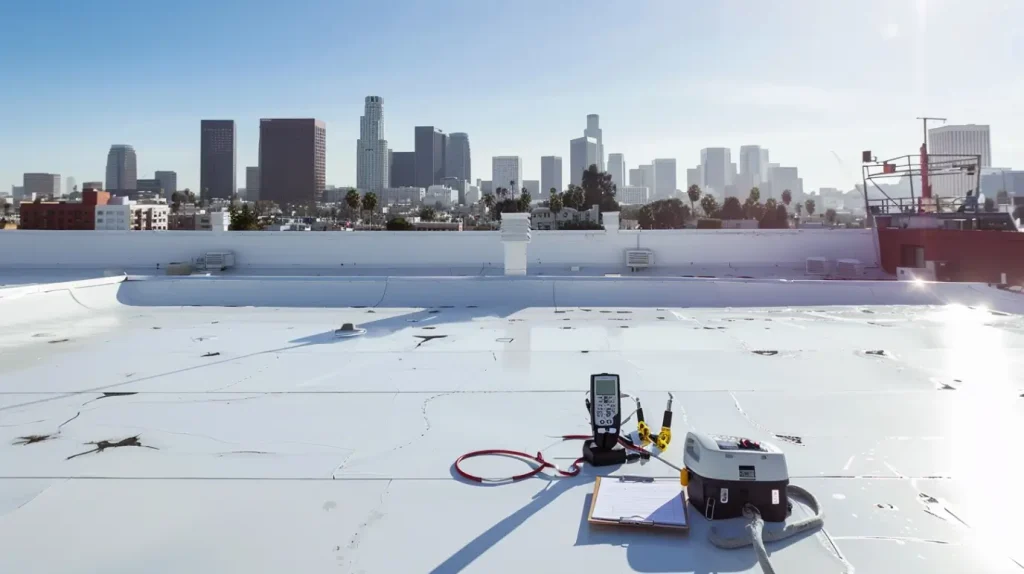
Phase 2: Equipment Calibration, Safety, and Overspray Control
SPF roofing is created by combining two liquid components:
- A-side: Isocyanate
- B-side: Polyol resin blend
Because the system is manufactured directly on the roof, spray equipment has to be properly calibrated before application begins. If ratio, temperature, or pressure are wrong, the resulting foam can become brittle, soft, crumbly, or poorly adhered.
Before spraying, we also establish the site controls that protect installation quality in dense Los Angeles commercial environments. That includes verifying dry weather, checking surface temperatures, masking adjacent surfaces, and setting stop-work thresholds for unsafe wind conditions. Overspray is not a side issue; it is a core part of installation planning. Contractors performing this work should operate strictly in line with Spray Polyurethane Foam Alliance (SPFA) application guidelines to protect neighboring buildings, vehicles, and rooftop equipment.
Phase 3: Foam Application and Drainage Engineering
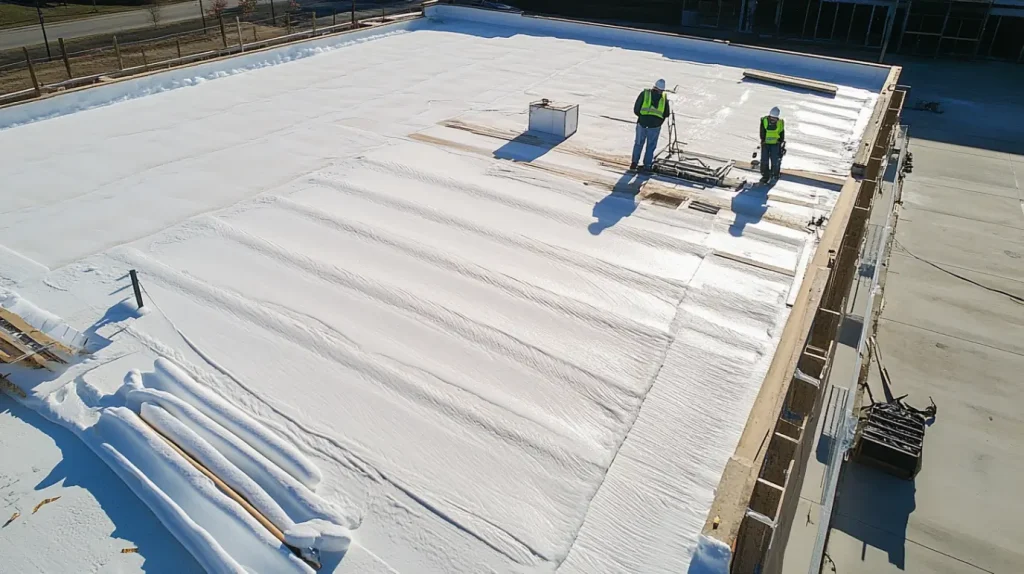
Once the roof is prepared and conditions are controlled, the foam application begins. The chemicals mix at the spray gun and react almost immediately, expanding into a rigid, closed-cell foam surface that adheres directly to the roof.
This is the stage where SPF becomes more than a coating. The installation has to create:
- consistent foam thickness
- strong adhesion
- durable detailing around penetrations and curbs
- smooth transitions at parapets and edges
- improved water flow toward drains and scuppers
For commercial roofing, SPF is commonly installed as medium-density closed-cell foam, often in the 1.5 to 2.5 lb/ft³ range. It typically delivers about R-5.8 to R-6.9 per inch, which is one reason it performs so well on hot-climate commercial roofs. In many projects, thickness across the field of the roof starts around 1.5 to 2 inches, then increases in low areas where the foam is used to improve slope and reduce ponding.
This is one of SPF’s biggest installation advantages. Instead of simply covering the existing roof, the foam can help reshape the roof. Low areas can be built up, drainage paths can be improved, and chronic birdbaths can often be corrected as part of the system design.
Phase 4: Curing and Silicone Coating Protection
Raw SPF is not the final weathering surface. Once the foam has been installed and checked for continuity, the system has to be protected with a compatible coating.
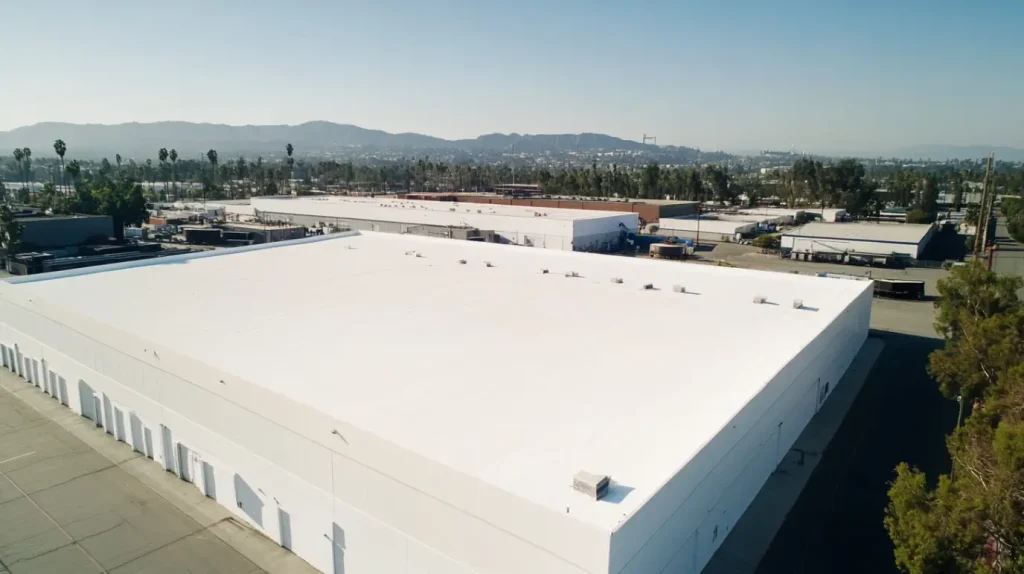
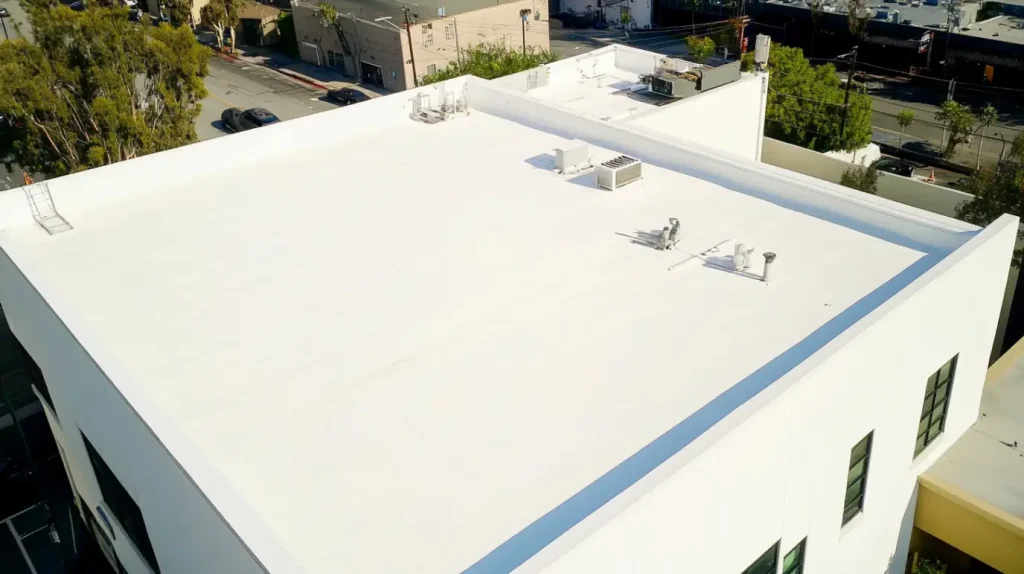
After the foam sets and cools, the coating process begins. In Los Angeles commercial applications, silicone is the preferred protective layer because it performs well under harsh UV exposure and resists ponding conditions perfectly. This stage usually includes a base coat followed by a highly reflective finish coat, which helps the building meet rigorous Cool Roof Rating Council (CRRC) standards for energy efficiency.
Commercial silicone systems over SPF are commonly built to a total dry film thickness of about 20 to 30 mils, depending on the specification. The coating is not cosmetic. It is the protective surface that shields the foam from UV degradation and premature wear. Without a properly installed silicone coating, the SPF system cannot deliver long-term performance.
Phase 5: Final Quality Control and Commercial Timeline
The final phase is where the installed SPF roof is confirmed as a complete system rather than just a finished spray job. At this stage, the roof should be reviewed for foam continuity, detail execution, coating coverage, drainage performance, and any visible defects that need correction before closeout.
Our final quality-control process typically includes:
- checking penetrations, parapets, and edge transitions
- confirming coating coverage and surface consistency
- reviewing drainage paths and low areas
- correcting visible defects or underbuilt sections
- providing post-installation guidance for roof access and maintenance
Owners also want to know how long an SPF installation takes. For many commercial roofs, the active installation window falls within several days to about one to two weeks, depending on roof size, weather, access, substrate correction, and detail complexity. Under favorable conditions, trained commercial crews may complete roughly 3,000 to 5,000 square feet per day, but production speed should never replace installation quality as the priority.
Why This Installation Process Matters in Los Angeles
A generic SPF article is not enough for a Los Angeles commercial owner. This market puts unusual stress on low-slope roofs: extreme sun, hot roof surfaces, periodic rain events, rooftop equipment, tenant-sensitive buildings, and neighboring property exposure all make execution more important.
At Foam Roofing Los Angeles, our installation process is built for those conditions. We do not treat SPF as a one-step spray application. We treat it as a commercial roofing system that has to be qualified, prepared, installed to the right thickness, shaped for drainage, protected with silicone, and closed out with full quality control. That is what gives SPF its value as a long-term roofing solution.
Conclusion
A step-by-step SPF roofing installation process should be disciplined, not vague. The sequence is straightforward when it is done correctly: qualify the roof, prepare the substrate, control the site conditions, install the foam to specification, protect it with silicone coating, and complete final quality control before closeout. That is the installation path that makes SPF roofing work on commercial buildings in Los Angeles. When those steps are followed with precision, SPF can deliver seamless waterproofing, strong insulation value, drainage improvement, and long-term roof performance.
Read also our blog: How Spray Foam Roofing Can Solve Your Roof Leak Problems
Frequently Asked Questions
Does every commercial roof qualify for SPF installation?
No. The roof has to be evaluated first for moisture, substrate condition, drainage, and structural suitability. Some roofs qualify for SPF recover or restoration, while others require corrective work before installation can begin.
How thick is SPF usually installed on a commercial roof?
That depends on the project goals, but commercial SPF is commonly installed as medium-density closed-cell foam and often starts around 1.5 to 2 inches across the field of the roof, with greater thickness used where drainage correction is needed. It typically provides about R-5.8 to R-6.9 per inch.
How long does a commercial SPF roof installation usually take?
For many projects, the active installation timeline falls within several days to about one to two weeks, depending on roof size, prep work, weather, access, and coating requirements.
Mail us for information
Emergency Phone